
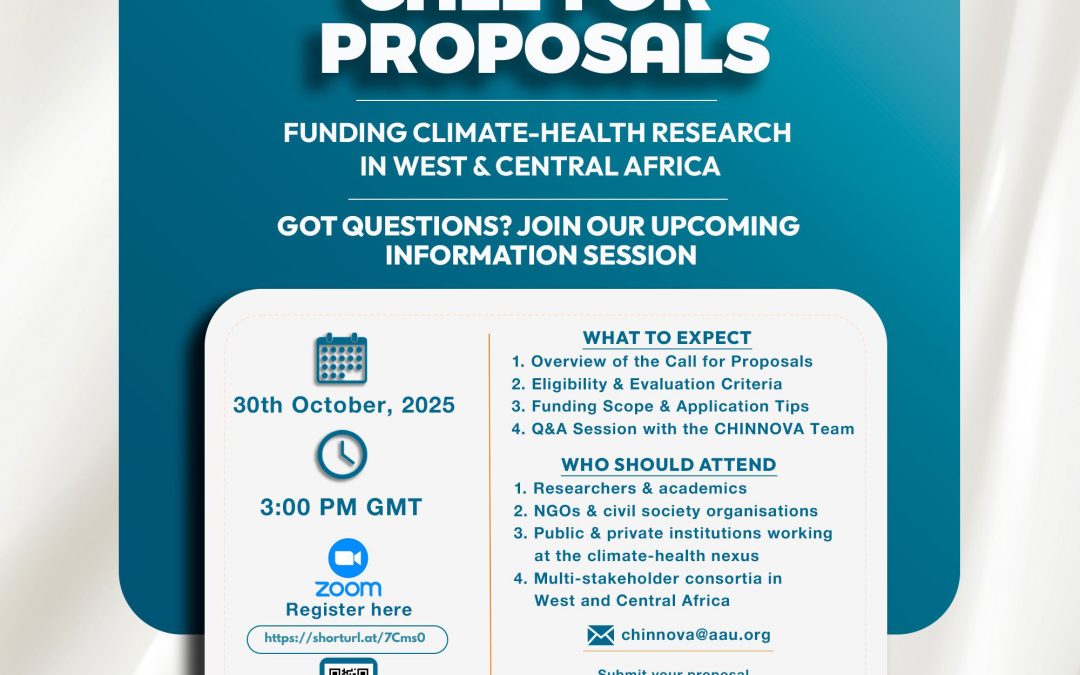
CHINNOVA Information Session Draws Strong Regional Participation Ahead of Major Research Funding Call
Following the launch of the Call for Proposals by the Climate Change and Health Innovation Hub for West and Central Africa (CHINNOVA) project, the Association of African Universities (AAU), together with its partners West African Science Service Centre on Climate Change and Adapted Land Use (WASCAL), Institut Pasteur de Côte d’Ivoire (IPCI) and Université Omar Bongo (UOB), organised a comprehensive Information Session to offer guidance to prospective applicants. The session formed part of a broader effort to promote high-quality, interdisciplinary research aimed at strengthening health system resilience in the face of climate change across West and Central Africa.
The AAU, through the CHINNOVA project, convened nearly 300 participants from across the continent and beyond. The virtual session attracted diverse participants from universities, research institutions, NGOs, government agencies and health organisations, with a significant number participating from Francophone institutions. This strong representation reflects the project’s commitment to bridging linguistic divides and ensuring inclusive engagement across West and Central Africa.
Building on this broad engagement, the session offered an opportunity to deepen understanding of the CHINNOVA initiative, which is implemented under the Advancing Research for Climate and Health (ARCH) programme and funded by Canada’s International Development Research Centre (IDRC) and the United Kingdom’s Foreign, Commonwealth and Development Office (FCDO). The initiative seeks to foster interdisciplinary and locally grounded research capable of addressing the complex intersection of climate change and health.
In his opening remarks, Prof. Frederick Ato Armah, Director of Research and Programmes, AAU and the Principal Investigator of the CHINNOVA project, underscored the purpose and urgency of the initiative, stating that:
“Over the last few years, it has become clear that in West and Central Africa, issues around high-quality data in the climate and health domain, particularly data that is useful for decision-making, remain a major challenge. We are using this initiative to address some of these issues on the continent. The goal is to ensure that we have a wide range of stakeholders that are involved in the knowledge generation and knowledge application process”.
Highlights from the Information Session
Participants received a detailed overview of the call’s objectives, thematic focus areas, eligibility requirements and expectations for competitive proposal development. Members of the consortium delivered presentations on the six priority thematic areas, which include health system preparedness, climate-sensitive diseases, gender and vulnerability, climate information and early warning systems, data interoperability, and policy and institutional innovations. The session was highly interactive, with participants seeking clarity on institutional eligibility, budget ceilings, collaboration requirements, ethical compliance and documentation expectations.
In response to questions on intellectual property during the Q&A session, Dr. Seyni Salack, Senior Scientist, Risks and Vulnerability to Climate Extremes, WASCAL assured participants that these concerns would be formally addressed during contracting, noting that,
“At the time of signing your contract, we will make sure that those things are clarified”.
Similarly, in addressing concerns about the career level required to lead a proposal, the consortium clarified that senior academic rank is not mandatory. Instead, applicants are expected to demonstrate relevant expertise and a strong track record capable of convincing reviewers of their capacity to lead and implement the proposed research.
Participants were also taken through a live demonstration of the CHINNOVA Grants Management System, the primary platform for proposal submissions. The system features a bilingual interface and a step-by-step application workflow that guides applicants through completing and uploading all required documents, making the submission process more structured and seamless.
The strong engagement throughout the session illustrated the region’s growing interest in climate–health research and set the stage for a competitive and impactful round of applications under the CHINNOVA Call for Proposals.
Call Details
The submission deadline, originally set for November 15, was extended to November 22 to allow applicants additional time to finalise their proposals. The review process is expected to be completed by the end of January 2026, after which successful applicants will be announced.
The CHINNOVA Call for Proposals aims to catalyse innovative, evidence-driven solutions that strengthen health system resilience amid the climate crisis. Recognising the growing effects of climate change on vulnerable populations, the call prioritises interdisciplinary and community-informed research that enhances preparedness for climate-induced health emergencies, promotes gender-responsive approaches and improves coordination across sectors to address gaps in data, policy and health system performance. The call will support between eight and ten collaborative research and innovation projects over 18 months from 2026 to 2027. Each selected team is eligible to receive up to USD 70,000, contributing to a total amount of USD 700,000.
Looking Ahead
This successful information session marks a significant step in advancing climate and health research across West and Central Africa. It reinforces the AAU’s leadership in convening stakeholders and supporting collaborative, evidence-based solutions to some of the region’s most pressing development challenges, while positioning the CHINNOVA initiative as a catalyst for stronger research capacity, regional cooperation and sustained policy impact in the years ahead. Ampla Tesouròs
